// guide
Does ChatGPT use Yelp or Google ratings? We checked 170 businesses on its map

Written by: Dmitry Filippov, Founder, GET-GEO.AI
Published: 2026-09-28 · Updated: 2026-09-29
// short answer
In the US and Canada, ChatGPT's map card usually shows the Yelp rating. Where Yelp and Google ratings differed, the card matched Yelp in 55 of 68 cases in Houston and Miami on 27 September 2026, and in 29 of 31 in Chicago and Toronto the next day. In London, Manchester and Sydney it mostly matched Google.
- Where Yelp and Google ratings differed, ChatGPT's map card matched Yelp in 55 of 68 cases in Houston and Miami, 18 of 20 in Chicago and 11 of 11 in Toronto (27–28 September 2026).
- In Houston and Miami, 59 of 116 cards showed a lower rating than Google, 17 by half a star or more; in Toronto, 10 of 28 were half a star or more below.
- In Manchester and Sydney the card equalled Google for all 45 service businesses we checked, and in London 9 of 12 comparable cards matched Google; restaurants there often showed Tripadvisor's rating.
- Only 12 of the 170 cards in our first run (27 September 2026) showed a review count, so a rating from four reviews looks the same as one from a thousand.
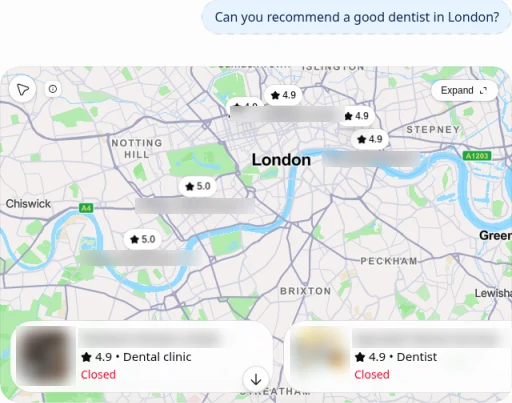
- "Can you recommend…" produced a ChatGPT map in 48 of 48 answers; "How do I choose…" in 7 of 12, with 2.8 businesses named on average instead of 5.4.
Does ChatGPT use Yelp or Google ratings on its map?
In the US and Canada, the star rating on a ChatGPT map card usually matches Yelp; in the UK and Australia it usually matches Google. We asked ChatGPT 30 local questions twice each on 27 September 2026, in Houston, Miami and London, and took every business shown on the map cards in its answers: 170 in all. Then we looked each one up on Google Maps, Yelp, Apple Maps, Bing Maps and, for restaurants, Tripadvisor, and compared the rating on the card with each platform.
Many businesses have the same rating everywhere, so a match on its own proves little. The telling cases are those where Yelp and Google disagree. In Houston and Miami there were 68 such businesses: the card matched Yelp for 55 of them, Google for 8 and neither for 5. The next day a second run gave the same result in Chicago (18 of 20) and Toronto (11 of 11). In London the pattern reversed: 9 of 12 cards matched Google.
This is consistent with the one public deal. Yelp and OpenAI announced on 23 July 2026 that ChatGPT would get Yelp's reviews, ratings, photos and business details; the financial terms were not disclosed and no countries were named. Our check shows the result on the card, not the contract behind it, and it compared star ratings only: it does not show how ChatGPT chooses which businesses to list, or whether it reads the text of Yelp reviews.
| Market and type | Matched Yelp | Matched Google | Matched neither | Businesses |
|---|---|---|---|---|
| Houston and Miami, seven non-restaurant niches | 46 | 7 | 2 | 55 |
| Houston and Miami, Italian restaurants | 9 | 1 | 3 | 13 |
| London, seven non-restaurant niches | 1 | 9 | 2 | 12 |
| Chicago, five niches (28 September) | 18 | 1 | 1 | 20 |
| Toronto, five niches (28 September) | 11 | 0 | 0 | 11 |
Why is your rating different on ChatGPT than on Google?
Because in the US and Canada the card usually shows your Yelp rating, and that is often lower. Of the 116 businesses we could compare in Houston and Miami on 27 September, 59 had a lower rating on ChatGPT's card than on Google, 17 of them by half a star or more; only 6 were rated higher. The widest gap was 2.3 stars. On 28 September, 17 of 24 Chicago cards were below Google, 3 of them by half a star or more; in Toronto 14 of 28 were below, and a larger share, 10, by half a star or more. In London, 9 of 53 were lower. A business that has built up its Google reviews for years can appear on ChatGPT's map with a score drawn from a different, often much smaller, set of reviews.
The examples below come from our screenshots. In the first, the card took Yelp's 3.0 from four reviews rather than Google's 5.0 from more than 150. The London row shows the reverse: the card followed Google. A reader of the card cannot tell these cases apart, because only 12 of the 170 cards in the first run showed a review count at all, all of them car repair shops.
| Business | ChatGPT card | Google (reviews) | Yelp (reviews) |
|---|---|---|---|
| Accounting firm, Miami | 3.0 | 5.0 (over 150) | 3.0 (4) |
| Dental practice, Houston | 4.0 | 4.9 (over 1,000) | 4.0 (about 100) |
| Veterinary clinic, Toronto | 3.3 | 4.2 (over 1,000) | 3.3 (about 50) |
| Car repair shop, London | 4.9 | 4.9 (over 400) | 4.4 (8) |
Does ChatGPT use Yelp ratings outside the US?
In Toronto, yes; in the UK and Australia the cards matched Google instead. In Toronto, all 11 businesses whose Yelp and Google ratings differed had the Yelp rating on the card, and none had Google's. Yelp's Canadian site blocked our browser with a CAPTCHA, so we took Yelp's rating from Apple Maps and Bing Maps, which show it under Yelp's name; the method section explains how we handled Bing's rounding.
In Manchester the card showed the Google rating for all 22 service businesses, and in Sydney for all 23 we found on Google, including figures from 4.5 to 4.8 that coincide less often by chance. Yelp blocked us with a CAPTCHA in both cities, so this is a match with Google, not a test against Yelp. In Chicago, for contrast, the card equalled Google for only 5 of 19 service businesses. London, from the first run on 27 September, points the same way: where Yelp and Google differed, the card matched Google in 9 of 12 cases and Yelp in 1. Only 18 of the 54 London businesses had a Yelp rating at all, against 82 of 116 in Houston and Miami.
Restaurants outside North America leaned towards Tripadvisor. The card matched Tripadvisor for 5 of the 7 London Italian restaurants whose Tripadvisor and Google ratings disagreed, and for 2 of 4 in Sydney; in Berlin all six restaurant cards showed Tripadvisor's rating. We have left out Berlin's other businesses and a second set of London niches: that part of our check did not meet our evidence standard and is being repeated.
We cannot say whether this reflects agreements or simply where Yelp has data. Yelp's own announcement of table reservations inside ChatGPT, on 10 August 2026, covers restaurants in the US and Canada; the July ratings deal names no countries. Beyond Houston and Miami our figures rest on a few dozen businesses per city, so treat them as an early observation. For the wider picture of the American market, see our guide to GEO in the USA.
| City | Card equal to Google | Businesses compared |
|---|---|---|
| Chicago | 5 | 19 |
| Toronto | 13 | 23 |
| Manchester | 22 | 22 |
| Sydney | 23 | 23 |
How did we check which platform ChatGPT uses?
We matched the rating on each ChatGPT card, within 0.05, against five platforms on the same day, and drew conclusions only from businesses whose Yelp and Google ratings differed. We did not ask ChatGPT where its data came from. In our pilot runs on 22 September 2026, the model said it had not searched the web in answers that showed web citations, so its account of its own sources is not evidence.
Counting any match would have misled us. 93 of the 170 cards showed 5.0 or 4.9, and such ratings often coincide on several platforms at once; counted that way, Google looks like the leading source. Apple Maps and Bing Maps are not independent sources either. 69 of the 82 Apple ratings we recorded were labelled as coming from Yelp, and of 108 Bing ratings, 28 were labelled Yelp and 7 Tripadvisor.
As a control we asked Google AI Mode the same questions and checked 20 businesses from its cards against Google Maps. All 16 cards that showed a numeric rating matched, so the method does pick out a known source.
In the second run, Yelp's sites in Canada, the UK and Australia blocked our browser with a CAPTCHA. Where Apple Maps or Bing Maps showed a rating attributed to Yelp, we used that figure; because Bing rounds to half a star, we counted the two ratings taken from Bing as consistent rather than exact matches. We re-read 156 platform screenshots against the recorded numbers and dropped every value that had no screenshot of its own.
Does the wording of the question change the map?
Yes: "Can you recommend…" questions got a ChatGPT map in 48 of 48 answers, "How do I choose…" questions in 7 of 12. We asked the second kind for dentists and plumbers in all three cities. Those answers named 2.8 businesses on average instead of 5.4, and two named none. Google AI Mode showed no map at all for the "How do I choose" questions, 0 of 12, though it still named businesses in the text.
When the map is there, it is the shortlist. In answers with a map, 92% of the businesses ChatGPT named in the text (280 of 305) also appeared on its cards, the pattern we first saw with law firms in our study of which lawyers AI assistants recommend. A business that is not on the map is rarely in the answer; our guide on why ChatGPT doesn't recommend you covers the usual reasons.
What do the buttons and labels on the card tell you?
They do not show where the rating comes from. The Directions button on the first card opened Google Maps in 52 of the 55 answers with a map; that is a route, not the source of the stars. Search Engine Land reported in July that Yelp branding and links would appear where OpenAI uses Yelp content. In our screenshots a Yelp label or link was visible in the opened card in 9 of the 55 map answers, all nine in the US; Tripadvisor appeared in 5, and OpenTable, the Better Business Bureau and WeddingWire occasionally.
So the card rarely tells a reader, or a business owner, where the stars came from. Comparing the number on the card with each platform on the same day is the only reliable test we found.
What should a local business check first?
In the US and Canada, check your Yelp profile first; in the UK and Australia, your Google Business Profile, plus Tripadvisor if you run a restaurant. On Yelp, claim the listing and check the name, category, address and hours. Do not ask customers for Yelp reviews: Yelp tells businesses not to request them, and its software may not recommend reviews that look prompted by the business. For Google and Tripadvisor the same rule applies: an accurate, complete listing and reviews earned without prompting.
Then look at your own card. Open ChatGPT in a Temporary Chat (a mode that does not use or save your chat history), ask two or three questions the way customers do, such as "Can you recommend a plumber in [your city]?", and screenshot the map. Compare the rating on your card with Google and Yelp on the same day, and repeat monthly; our guide on checking your AI visibility sets out a fuller protocol. If you would rather have it checked for you, our free audit looks at your card, which platform its rating matches, and how the map changes with the wording of the question.
How was the study run, and what are its limits?
On 27 September 2026, between 12:01 and 15:53 UTC, we asked ChatGPT and Google AI Mode the same 30 questions, twice each. ChatGPT ran on a free account in Temporary Chat with memory off, in a desktop browser; AI Mode ran in a private window without a login. Twenty-four questions asked for recommendations in eight niches (dentist, plumber, small-business accountant, car mechanic, vet, wedding photographer, engagement-ring jeweller, Italian restaurant) across Houston, Miami and London; six asked how to choose a dentist or a plumber. The city was named in each question, and the browser's location was not changed. That gave 120 answers, all recorded as screenshots. On the same day we checked 170 businesses from ChatGPT's cards and 20 from AI Mode's on the five platforms.
On 28 September 2026, between 17:12 and 18:04 UTC, we asked ChatGPT 30 more recommendation questions, once each and with the same setup: dentist, plumber, car mechanic, vet and Italian restaurant in Chicago, Toronto, Sydney, Manchester and Berlin, and electrician, physiotherapist, hair salon, locksmith and sushi restaurant in London. All 30 answers showed a map, with 166 businesses on the cards, which we checked on the same five platforms that evening and verified against the screenshots the next day.
We compared ratings only; this study does not show where ChatGPT gets its list of businesses or how it ranks them. The first run covers one day, three cities, eight niches and English. The second asked each question once, and in every city except Houston and Miami the figures rest on dozens of businesses, not hundreds. OpenAI's help page describes maps on iOS and Android; we recorded the desktop web version, which showed maps as well. Interfaces change, so treat these figures as a dated measurement. The full table of 190 businesses, with the rating on every platform, is published as a CSV file, and the 166 from the second run as a separate CSV file, where values we could not verify, including the Berlin and London checks we set aside, are left blank; our note on how we measure describes our general method.
Related questions
Does ChatGPT use Google reviews for local businesses?
In the UK and Australia it appears so: on 28 September 2026 every service-business card we checked in Manchester and Sydney showed the Google rating. In the US and Canada the card usually followed Yelp, so a strong Google rating helps there only if your Yelp rating is just as strong.
Does the Yelp and ChatGPT deal apply outside the US?
The ratings deal announced on 23 July 2026 names no countries, and Yelp's own announcement of 10 August 2026 limits table reservations to the US and Canada. In our check, Toronto cards followed Yelp just as American ones did, while British and Australian cards matched Google. Check which platform your own card matches before deciding where to spend your time.
Can I change the rating ChatGPT shows for my business?
Not in ChatGPT itself. The number on the card followed the rating on one platform in our check, so it moves only when that rating moves, and replying to reviews does not change an average. What you can do is keep that profile accurate, earn reviews honestly, and compare the platform and your card side by side each month.
Does Google AI Mode show the same ratings as ChatGPT?
Not always. AI Mode's cards matched Google Maps in all 16 cases we could check, while ChatGPT's matched Yelp in the US. A business whose Google and Yelp ratings differ can therefore show two different scores on the same day, depending on which assistant a customer asks. Where the two platforms agree, the cards agree too.
Related guides
Sources
- 01GET-GEO.AI research dataset: 120 answers from ChatGPT and Google AI Mode to 30 local questions in Houston, Miami and London, and 190 businesses checked on Google Maps, Yelp, Apple Maps, Bing Maps and Tripadvisor, 27 September 2026
- 02GET-GEO.AI research dataset, second run: 30 ChatGPT answers to local questions in Chicago, Toronto, Sydney, Manchester, Berlin and London, and 166 businesses checked on the same five platforms, 28 September 2026
- 03Axios — Yelp deal pushes local reviews into ChatGPT (23 July 2026)
- 04Search Engine Land — ChatGPT gains access to Yelp reviews, ratings, and photos (23 July 2026)
- 05Yelp Official Blog — Yelp brings Reservations and Waitlist to ChatGPT (10 August 2026; US and Canada)
- 06Yelp Support Center — Don't Ask for Reviews
- 07OpenAI Help Center — Searching the web with ChatGPT (maps on iOS and Android; trusted third-party providers for nearby business listings)
- 08Our study: which lawyers AI assistants recommend, and why the map decides
- 09Our guide: why ChatGPT doesn't recommend your business
- 10Our guide: GEO in the USA
- 11Our guide: how to check your AI visibility, with repeat runs and recorded sources
- 12Our guide: how we measure AI visibility
// share
How to cite this page
You may quote and reuse this content with attribution and a link to this page.
“Does ChatGPT use Yelp or Google ratings? We checked 170 businesses on its map” — GET-GEO.AI, 2026-09-29. https://get-geo.ai/en/guides/where-chatgpt-gets-business-ratings