// guide
Which lawyers does ChatGPT recommend, and how does it choose? A study of 72 AI answers

Written by: Dmitry Filippov, Founder, GET-GEO.AI
Published: 2026-09-24 · Updated: 2026-09-28
// short answer
ChatGPT mostly recommends the law firms shown on its map of local business listings, not the firms whose websites it cites. In our study of 72 answers on 22 September 2026, it showed a map in 11 of 12 lawyer searches and cited directories and bar associations. Perplexity cited firm websites far more often.
- In our 22 September 2026 study, ChatGPT put a map of local firms above its answer in 11 of 12 lawyer searches; 43 of the 63 firms it named were on the map's cards.
- Only 8 of ChatGPT's 71 source links (11%) went to a law firm's own site; directories took 42%, and bar associations, regulators and government pages 35%.
- Perplexity cited a law firm's own site in all 24 of its answers, 174 of its 390 links in total.
- Asked how to choose an immigration lawyer, Perplexity named no firm in any of its six answers and Google AI Mode none in four of six; ChatGPT named four or five each time.
- Across two runs of the same prompt, ChatGPT kept 3.9 of about 5.6 firm names, Perplexity 1.7 of 3.7 and AI Mode 1.4 of 4.2.
How does ChatGPT choose which law firms to recommend?
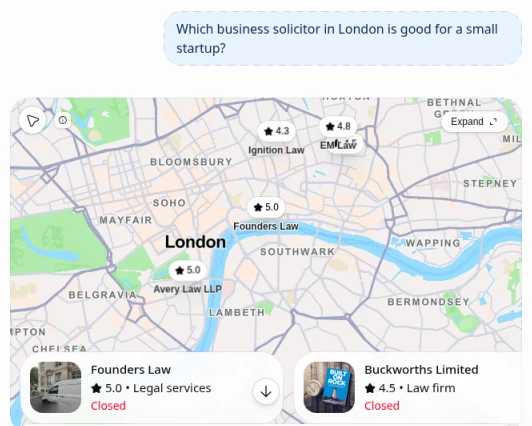
ChatGPT takes its law firm names mainly from a map of local businesses that it places above the written answer. We asked ChatGPT, Perplexity and Google AI Mode 12 lawyer-search prompts, twice each, on 22 September 2026; the method and its limits are set out in the last section. In the first run, 11 of ChatGPT's 12 answers opened with a map and a row of business cards, each showing the firm's name, star rating, category and whether the office was open. Across those 11 answers, 43 of the 63 firms named in the text appeared on a card, and every firm shown on a card was named. The cards scroll sideways and only part of the row fits on screen, so 43 is a lower bound.
The pages ChatGPT cited pointed elsewhere. Of its 71 source links, 30 (42%) went to directories and rankings, and 25 (35%) to bar associations, regulators and government pages such as texasbar.com, floridabar.org and sra.org.uk. Law firms' own sites received 8 links (11%), in 5 of the 24 answers. On the immigration prompts, bar and government pages made up 77% of what it cited; on the other prompts, directories and "best lawyers" rankings led. The names that were not on the cards mostly appeared next to directory citations. The London divorce answer, for example, added seven firms to the three on its cards, among them Mishcon de Reya, Payne Hicks Beach and Vardags, while citing two London family-law rankings.
The form of the names points the same way. ChatGPT reproduced several of them the way a business listing reads, with the service and the city attached: "Business Lawyer Miami - Cueto Law Group", "Stowe Family Law LLP - Divorce Solicitors London", "Abbasi Immigration Law Firm - Immigration Attorney Houston". OpenAI's help page on ChatGPT search, checked on 24 September 2026, says that on iOS and Android relevant results may include a map (we saw one on the web as well) and that ChatGPT may share the user's location with "trusted third-party providers" for "nearby business listings". It does not name those providers, so we call the source "local business listings" rather than attribute it to a single platform.
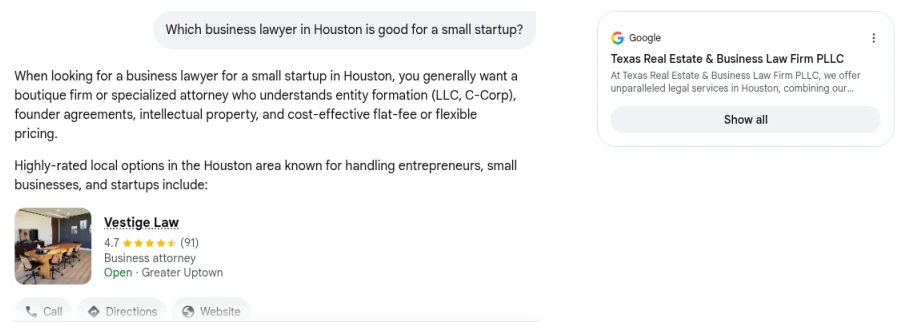
Google AI Mode does the same, but less consistently. It showed a map or business cards in at least 11 of its 24 answers, covering eight of the 12 prompts; on three prompts the cards were confirmed in both runs, and on three more one screenshot was taken below them. In all but one answer with legible cards, the firms on them were among those named in the text. Google's guide to its AI search features names Google Business Profile as a source of local business details, which fits what we saw.
Which sources do ChatGPT, Perplexity and Google AI Mode cite for lawyer searches?
ChatGPT cited mostly directories and regulators, Perplexity cited firm sites and directories in almost every answer, and Google AI Mode showed mostly cards bearing a firm's name. ChatGPT averaged three sources per answer, Perplexity about 16 and AI Mode just under three. Perplexity cited a firm's own site in all 24 of its answers and a directory in 23. In AI Mode, 41 of 68 sources were cards with a law firm's name; on most of them the destination was not shown, so some may lead to a business listing rather than the firm's website.
By number of links, the domains cited most often by ChatGPT and Perplexity were texasbar.com (19 links in 5 answers), floridabar.org (15 in 7), legal500.com (14 in 8), attorneys.superlawyers.com (13 in 12), justia.com (12 in 11), chambers.com (11 in 7), sra.org.uk (9 in 3) and avvo.com (8 in 8). Counted by answers, the directories come first: Super Lawyers and Justia appeared in 12 and 11 answers, the state bars in 5 to 7.
The sources also differ by market. With all three assistants pooled, directories and rankings made up 35% of London sources against 28% in Houston and Miami, and media 9% against 2%; every media link came from Perplexity. Firm sites took 44% of US sources and 37% of London's. The regulators cited were the State Bar of Texas and the Florida Bar in the US, and the SRA in London, with the Law Society's register beside it. The main directories did not cross over: Super Lawyers, Justia and Avvo never appeared in a London answer, and Chambers and Legal 500 never in a US one.
| Source type | ChatGPT (n=71) | Perplexity (n=390) | Google AI Mode (n=68) |
|---|---|---|---|
| Directories and rankings | 30 (42%) | 115 (29%) | 16 (24%) |
| Law firm's own site (AI Mode: card with a firm's name) | 8 (11%) | 174 (45%) | 41 (60%) |
| Bar associations, regulators, courts, government, legal aid | 25 (35%) | 48 (12%) | 6 (9%) |
| Media | 0 | 23 (6%) | 0 |
| Forums | 0 | 8 (2%) | 2 (3%) |
| Other | 8 (11%) | 22 (6%) | 3 (4%) |
| Answers citing at least one directory | 18 of 24 | 23 of 24 | 10 of 24 |
| Answers citing a firm's own site (AI Mode: card with a firm's name) | 5 of 24 | 24 of 24 | 20 of 24 |
Which law firms were named most often, and do the names repeat?
Ten firms were named in five or more of the 72 answers, and nine of them came from two prompt types: London personal injury and business law for a startup. Most names appeared once or twice. Across two runs of the same prompt, ChatGPT kept 3.9 firm names on average, Perplexity 1.7 and AI Mode 1.4, out of about 5.6, 3.7 and 4.2 names per answer; we count variants such as "Stewarts" and "Stewarts Law LLP" as one firm. Perplexity's average includes the three immigration prompts where it named nobody.
Only two of the 12 prompts produced a firm named in all six answers, three assistants by two runs. On London personal injury, Anthony Gold, Fieldfisher and Stewarts appeared every time; neither ChatGPT nor AI Mode showed a map there, and the answers cited the Chambers and Legal 500 rankings. On Miami business law for a startup, Cueto Law Group appeared every time, this time with maps on screen, and its own site, cuetolawgroup.com, was cited in four of the six answers.
Where AI Mode answered from its cards, the names moved most: on the eight prompts with cards it kept 1.3 names between runs, against 7 on London personal injury. ChatGPT's map answers were steadier, with about four names repeated. For a firm, a single screenshot of being named, or missing, says little; three or more runs per prompt, with the map recorded next to the text, is the minimum for a figure worth acting on. Our guide on how to check your AI visibility sets out that protocol.
| Firm | Prompt where it was named | Answers (of 72) |
|---|---|---|
| Stewarts | London personal injury (6), London divorce (2) | 8 |
| Anthony Gold | London personal injury | 6 |
| Fieldfisher | London personal injury | 6 |
| Cueto Law Group | Miami business law for a startup | 6 |
| Irwin Mitchell | London personal injury | 5 |
| Leigh Day | London personal injury | 5 |
| Thompsons | London personal injury | 5 |
| Harper James | London business law for a startup | 5 |
| Lloyd & Mousilli | Houston business law for a startup | 5 |
| Zehl & Associates | Houston personal injury | 5 |
When do AI assistants name no lawyer at all?
Rarely, except when the prompt asked how to choose. All three immigration prompts were worded "How do I choose an immigration lawyer in…". Perplexity named no firm in any of its six answers to them, and AI Mode named none in four of six; both answered with guidance on choosing a lawyer. On the nine prompts that asked for the best lawyer, a recommendation or a good fit, every answer from every assistant named at least two firms.
ChatGPT, by contrast, named four or five immigration firms every time, with its map above the guidance. Across its 24 answers it always named firms, between four and ten per answer and 5.6 on average, against 3.7 for Perplexity and 4.2 for AI Mode.
The answers that named nobody still cited law firms. In Perplexity's six immigration answers, 45 of 105 links went to firms' own sites, many of them firms' articles on how to choose an immigration lawyer. ChatGPT's immigration citations were 77% bar and government pages. Because only the immigration prompts used the how-to wording, the study cannot tell whether immigration makes assistants cautious or whether any "how do I choose" question would do the same; a follow-up test with "best immigration lawyer" wording would settle it.
| Practice area and wording | ChatGPT | Perplexity | Google AI Mode |
|---|---|---|---|
| Personal injury, "best …" | 6.3 (0 of 6) | 6.2 (0 of 6) | 5.5 (0 of 6) |
| Immigration, "how do I choose …" | 4.5 (0 of 6) | 0 (6 of 6) | 1.8 (4 of 6) |
| Divorce, "recommend …" | 5.8 (0 of 6) | 3.8 (0 of 6) | 5.0 (0 of 6) |
| Business law, "which … is good for a small startup" | 5.8 (0 of 6) | 4.7 (0 of 6) | 4.5 (0 of 6) |
What do the findings mean for a law firm's listing, directories and website?
They mean the business listing does more work in ChatGPT than the website does, and the directories that matter depend on the city. Our guide on how a law firm gets recommended by ChatGPT and other AI assistants covers the page format and the bar advertising rules; each point below ties one finding from this study to what it implies.
- ChatGPT named firms from its map cards in 11 of 12 searches, so the business listing is a page in its own right. The firm's name should read exactly as on the website and in every directory, with the right category for each practice, current hours and a working website link.
- ChatGPT's cards showed a star rating next to each name, and AI Mode's showed the rating and the review count. This study did not test whether those numbers decide who is picked, but every client reading the answer sees them.
- Directories and rankings were 42% of ChatGPT's sources and appeared in 23 of Perplexity's 24 answers, and the main directories differed between the US and London. A firm should check which directories the assistants cite for its own city before paying for any listing.
- Bar and government pages were 77% of ChatGPT's citations on the immigration prompts. The firm's record with its state bar or the SRA should match the firm's own description, because that is where a reader asking how to choose is sent.
- Perplexity cited a firm's own site in every answer, including answers that named no firm. A page per practice area and city, and an article on how to choose a lawyer in that practice, give it something to cite.
How was the study run, and what are its limits?
We typed 12 prompts, four practice areas in three cities, into ChatGPT, Perplexity and Google AI Mode, twice each, in a fresh session every time, on 22 September 2026 between 19:55 and 21:19 UTC. That produced 72 answers, all of which cited at least one source. ChatGPT no longer answers these prompts without an account, so we used a free account in Temporary Chat, with memory off and no custom instructions. Perplexity showed a sign-up wall after the first signed-out answer, so we used a logged-in Pro account with history and personalisation off. Google AI Mode was used signed out, in a private window. All sessions ran from one computer outside the three cities, without a VPN; the maps followed the city named in the prompt.
We recorded sources only as the interface displayed them: citation previews in ChatGPT, the Sources panel in Perplexity, source cards in AI Mode. We never asked an assistant which sources it had used, because in earlier tests that self-report did not match the citations on screen. Each source was sorted into one of six types: legal directories and rankings; a law firm's own site; bar associations, regulators, courts, government and legal-aid sites; media; forums; and other. On 24 September 2026 we reconciled the type counts with the listed links, which changed 12 of the 72 rows.
The study covers one evening, three cities, one language and two runs per prompt, so treat the figures as a first measurement of how assistants handle lawyer searches; it is not a ranking of firms. The three assistants ran in different modes because each product allows different things. Maps were counted from screenshots of ChatGPT and AI Mode only; six of ChatGPT's 12 second-run screenshots were taken below the map, so its map figure uses the first run. The provider behind ChatGPT's listings is not documented. Only "lawyer" and "solicitor" were tested, not "attorney", and Gemini and AI Overviews were not part of this study. On 14 September 2026, ChatGPT used without an account answered "best immigration lawyer in Houston" twice by naming only directories (Avvo, Expertise, CityVetted) and no firms; the mode, the wording or both may explain the difference, and we have not tested which.
We have published the full table of 72 answers as a CSV file with every named firm and every recorded source, including whether the screenshot showed a map. If you run a law firm and want the same measurement for your own city and practice, start with our free AI visibility audit. It covers ten prompts in one language where you are invisible today, the current answers, the specific changes we recommend, and a check of crawler access. Email hello@get-geo.ai with your site and your practice areas.
| Practice area | Houston and Miami | London |
|---|---|---|
| Personal injury | "Best personal injury lawyer in [city]" | "Best personal injury solicitor in London" |
| Immigration | "How do I choose an immigration lawyer in [city]?" | "How do I choose an immigration solicitor in London?" |
| Divorce | "Recommend a divorce lawyer in [city]" | "Recommend a divorce solicitor in London" |
| Business law | "Which business lawyer in [city] is good for a small startup?" | "Which business solicitor in London is good for a small startup?" |
Related questions
Does ChatGPT recommend specific lawyers by name?
Yes, and more readily than the other two assistants we tested. It named firms in every one of its 24 answers, even when the prompt only asked how to choose a lawyer. Do not read much into a single session, though: a firm named once may be missing the next time the same question is asked.
Does ChatGPT use Google Business Profile to recommend law firms?
OpenAI's help page names no providers, but in the US the evidence now points to Yelp. Yelp announced on 23 July 2026 that ChatGPT would get its reviews and ratings, and in our later check of 170 businesses, US map cards usually matched Yelp while London cards matched Google. Keep the firm's details identical on both.
Do reviews and star ratings affect which lawyers ChatGPT recommends?
This study cannot say. ChatGPT's cards showed each firm's star rating beside its name, and Google AI Mode's showed the rating and the number of reviews, so every client reading the answer sees them. Testing whether ratings decide who is named would need firms with different ratings compared on one prompt across many sessions.
Are legal directories still worth paying for?
Some are, and which ones depends on the market. Firms that ChatGPT named beyond its map cards usually came with a directory citation, and the most stable shortlist in the study, London personal injury, appeared where the answers cited Chambers and Legal 500. Check which directories appear in answers for your city before paying for a listing.
Does this apply to law firms outside the US and the UK?
We tested only Houston, Miami and London, in English. Other markets have their own regulators, directories and listing coverage, so the mix of sources is likely to differ. The method should carry over: use the prompts your clients type, record the map and the sources as well as the names, and ask each prompt at least three times.
Related guides
Sources
- 01GET-GEO.AI research dataset: 72 answers from ChatGPT, Perplexity and Google AI Mode to 12 lawyer-search prompts in Houston, Miami and London, 22 September 2026
- 02OpenAI Help Center — Searching the web with ChatGPT (maps in results on iOS and Android; third-party providers for nearby business listings)
- 03Google Search Central — Optimizing your website for generative AI features on Google Search (Google Business Profile as a source of local business details)
- 04Our guide: how a law firm gets recommended by ChatGPT and other AI assistants
- 05Our guide: how to check your AI visibility, with repeat runs and recorded sources
// share
How to cite this page
You may quote and reuse this content with attribution and a link to this page.
“Which lawyers does ChatGPT recommend, and how does it choose? A study of 72 AI answers” — GET-GEO.AI, 2026-09-28. https://get-geo.ai/en/guides/which-lawyers-do-ai-assistants-recommend